Simon Doyle–Jacqueline de Bellefort relationship
Death on the NileSimon Doyle and Jacqueline de Bellefort move from an engagement built around shared devotion and plans for marriage to a relationship defined by betrayal, resentment, and Jacqueline’s pursuit of Simon after he marries Linnet Doyle. Their change is not simply a broken engagement: Jacqueline continues to regard Simon as belonging to her even after he has chosen another life, while Simon’s conduct shifts from hopeful participation in their plans to silence and resistance during her accusations.
Engagement and plans for a shared future
Jacqueline presents Simon as the man she loves and cannot imagine living without. He is poor, has lost his office job, and comes from an impoverished country family; she describes him as straightforward, boyish, and suited to estate work. Rather than treating these circumstances as obstacles to their engagement, she asks Linnet, her friend, to give Simon a position managing her newly acquired estate. She proposes that he be dismissed if he fails, but expects him to succeed. The request makes their future depend partly on Linnet’s practical help, even as Jacqueline speaks of marriage as the culmination of her love for Simon.
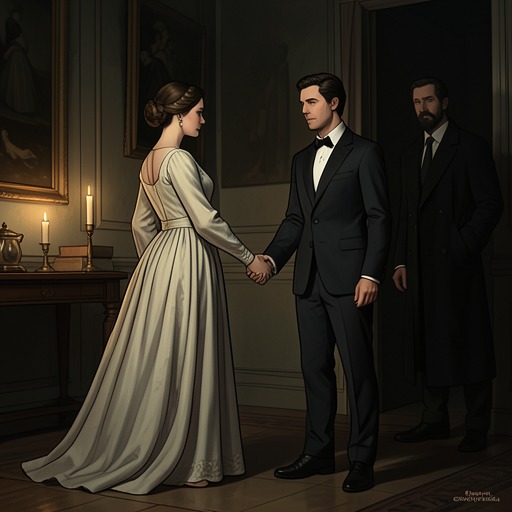
Simon appears to accept both the proposed work and the life Jacqueline imagines. He says he believes he can do the job and intends to succeed for her sake. They discuss waiting three months to ensure he keeps the position before marrying, and plan to spend their honeymoon in Egypt, a destination Jacqueline has long wanted to visit. The concrete sequence—employment, a period of waiting, marriage, and travel—gives their engagement the shape of a shared plan. Yet their exchange also contains an imbalance Jacqueline herself senses: she wonders whether Simon cares for her as much as she cares for him. His sharp dismissal of that doubt reassures her only briefly; the question remains an early sign of the difference she later makes central to her account of their relationship.
The broken engagement and competing accounts
Simon breaks off his engagement to Jacqueline and marries Linnet, who had been Jacqueline’s friend. Linnet later explains to Hercule Poirot that Simon and Jacqueline had been engaged, that Simon ended it, and that Jacqueline took the decision badly. Linnet says she had paid little attention to Jacqueline’s threats, but reports that Jacqueline instead began following the couple wherever they went. Her account presents the pursuit as the aftermath of a broken engagement that has become an ongoing intrusion into the marriage.
Jacqueline’s account gives the rupture a more intimate and accusatory meaning. She insists that she and Simon loved one another and that she also loved and trusted Linnet, whom she regarded as her best friend. In her view, Linnet’s habitual ability to obtain what she wanted extended to Simon: Linnet saw him and took him. Jacqueline does not describe Simon as having freely transferred his affection so much as having been overwhelmed by Linnet’s wealth, confidence, and commanding manner. She compares Linnet to the sun and herself to someone eclipsed by its brightness, while describing Simon as weak or simple enough to be dazzled. These are Jacqueline’s explanations, not an independent account of Simon’s motives.
Her claims about Simon’s feelings are themselves divided. Jacqueline says that he loved her and would always love her, but, when Poirot asks whether this remains true, she acknowledges that Simon hates her now. The contrast exposes the distance between the future she once expected and the relationship she is actually living. Her certainty that their bond remains decisive persists alongside her recognition that Simon no longer returns her love.
Pursuit, accusation, and violence
Jacqueline turns the separation into a deliberate pursuit of the newlyweds. She says she had acquired a small pistol after the rupture and had considered killing either Simon or Linnet, but could not decide between them. She then chose to wait and follow them. At distant places where Simon and Linnet were together, her unexpected presence disturbed their happiness; Jacqueline says that making Linnet feel her presence became a source of satisfaction. Her polite conduct toward the couple made the pursuit harder to challenge directly, while, in Jacqueline’s own description, its repeated presence poisoned their enjoyment of their travels.
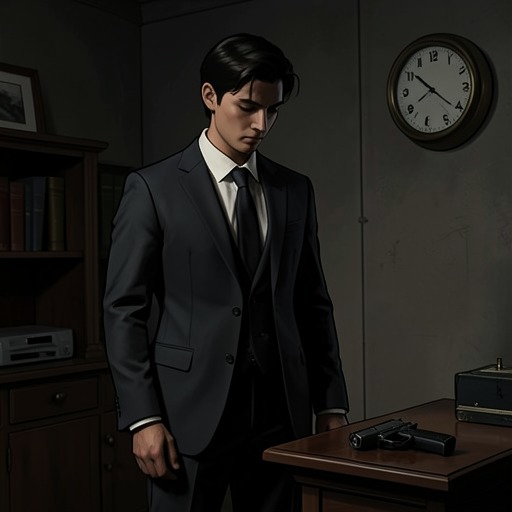
The conflict becomes explicit aboard the Karnak. In front of Cornelia Robson, Jacqueline announces that she and Simon were once engaged and frames the history as a sad one in which Simon treated her badly. Simon looks angry and tells her to go to bed, but stays when she challenges him to leave. Later, Jacqueline accuses him of believing he can treat her as he has and escape the consequences. Simon does not answer; he sits still as though waiting for the outburst to pass. Jacqueline then asserts that Simon belongs to her and repeats her threat to kill him rather than see him with another woman. When she raises the pistol, Simon finally gets to his feet, and she pulls the trigger. The former engagement has become a direct confrontation in which Jacqueline’s claim of continuing love is expressed as a threat, and Simon’s response is no longer participation in a shared future but an attempt to meet the immediate danger.
The relationship’s transformation
The relationship’s arc turns on the gap between mutual plans and Jacqueline’s later insistence that Simon remains hers. Early on, she asks Linnet to help Simon establish himself and imagines marriage, a home, and travel together. After Simon ends the engagement, Jacqueline recasts the loss as a contest in which Linnet’s wealth and force have taken him from her. Her pursuit keeps the former couple physically connected to the story of their engagement, but it does not restore their earlier intimacy; instead, each recurrence sharpens the contrast between Jacqueline’s attachment and Simon’s rejection.
The relationship also shapes Jacqueline’s hostility toward Linnet. Linnet is not only Simon’s new wife but the friend Jacqueline says she trusted and loved. Jacqueline’s sense of betrayal therefore joins the loss of her fiancé to the loss of confidence in her friend. Her explanation repeatedly treats Simon’s choice as something produced by Linnet’s influence, while her own recollection of their engagement emphasizes the depth and permanence she attributed to his love. That tension helps explain why the broken engagement does not become a finished episode for Jacqueline: she continues to interpret the present through the relationship she believes should have endured, until pursuit and accusation replace the future the pair once planned.